Helium bubble flow visualization
The principle
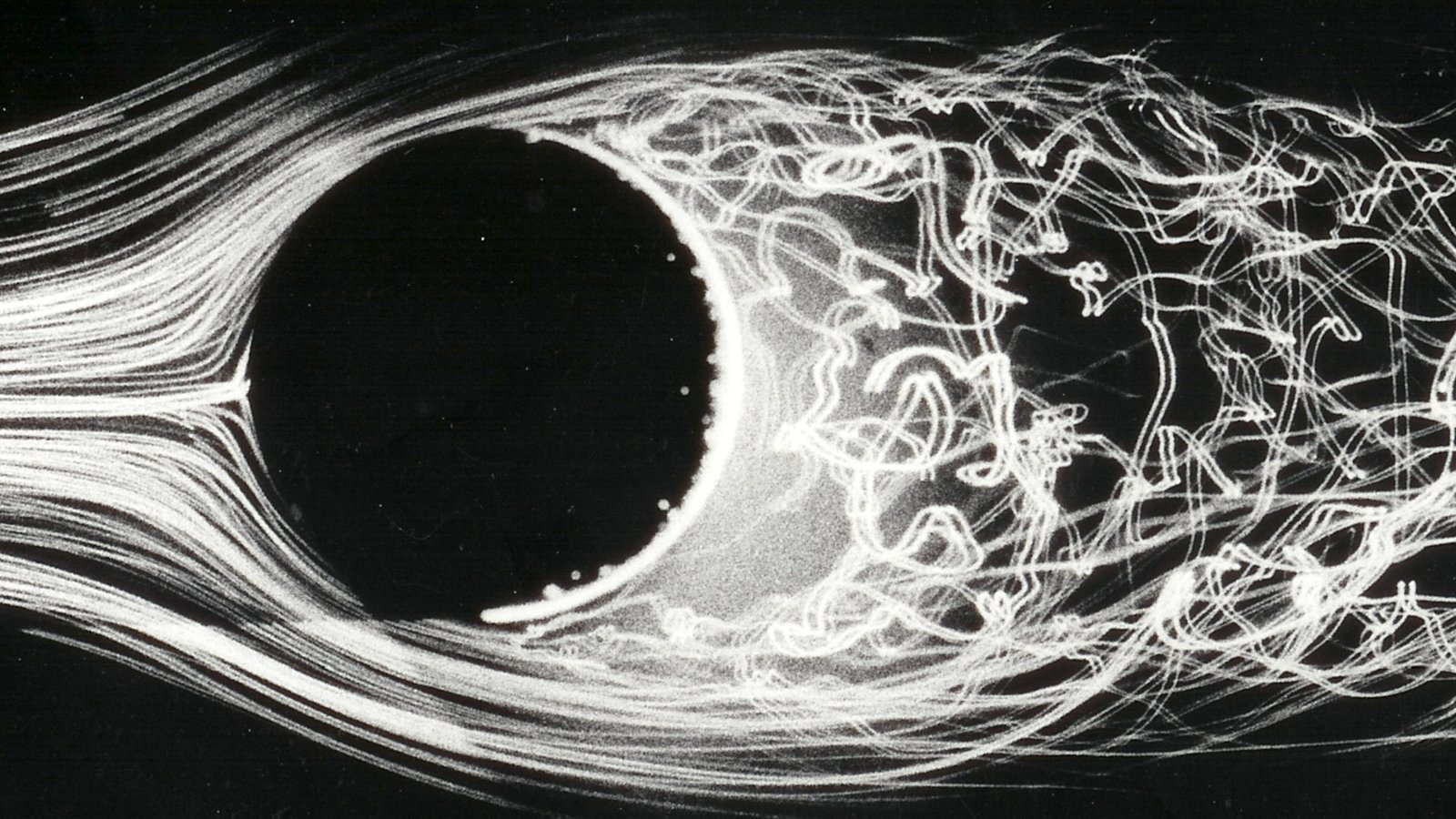
A soap bubble filled with air falls. A soap bubble filled with pure helium rises. Between those two states is a mixture that carries exactly enough helium to offset the weight of the film — and that bubble neither rises nor falls. It has no net buoyancy, so it has no motion relative to the air around it.
It goes where the air goes.
That is the whole idea, and it is why the technique produces streamlines rather than approximations. A tracer with residual buoyancy drifts across streamlines; a neutrally buoyant one does not.
Getting there in practice
Neutral buoyancy is a target, not a guarantee. A generator producing 300 to 400 bubbles per second will produce some that are too heavy and some that are too light. The Mini-Vortex Filter exists to remove them: a tangential jet of air sets the stream into cyclonic motion, and bubbles outside the neutral band are separated out before they ever reach the test section.
What continues downstream is a filtered population of bubbles that trace the flow.
What it will do
| Bubble diameter | 1–4 mm, adjustable at the console |
| Film wall thickness | ≈ 1 micron |
| Generation rate | 300–400 bubbles/sec per head |
| Visible flight time | 1–2 minutes or longer |
| Flow speed traced | to 60 m/s |
| Rotating machinery | Passes through fans at high rpm without impact damage |
| Flow regimes | Laminar, turbulent, steady, unsteady |
Making it quantitative
Illumination is not just for seeing. With a modulated arc lamp, the light is switched on and off at independently adjustable intervals — from 1.0 to 50 milliseconds each. A continuous bubble trace becomes a dashed line where every dash represents a known interval of time.
Measure the dash spacing in a photograph and you have bubble velocity. Because the bubbles are neutrally buoyant, that is also air velocity.
This is what separates a modulated arc lamp system from any other light source: it turns a picture of the flow into a measurement of it.
Where the method comes from
Sage Action developed the neutrally buoyant bubble technique under Office of Naval Research funding and published it in Naval Research Reviews in June 1971. The method has been in continuous use since, in wind tunnels, cleanrooms, ventilated agricultural buildings, operating rooms, and full-scale industrial spaces.