See what the air is doing.
Sage Action builds helium bubble generator systems for airflow and flow visualization. Neutrally buoyant bubbles trace streamlines at speeds to 60 m/s — through wind tunnels, cleanrooms, ventilated spaces, and rotating machinery.
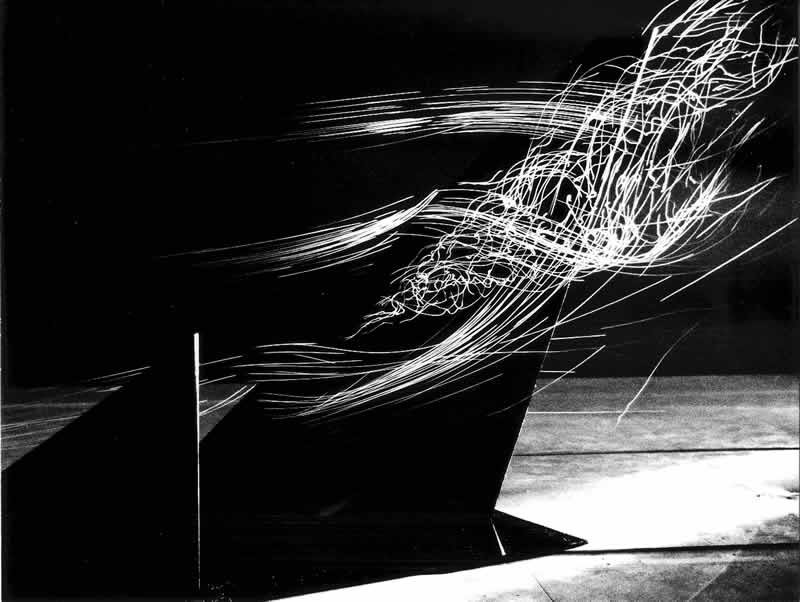
Helium bubble streaklines over a canard wing model — flow separation and vortex structure, wind tunnel test.
Developed under Office of Naval Research funding · Published 1971 · Manufactured continuously since 1972
Airflow is invisible. Your data isn't the same as your flow field.
Pressure taps, hot wires, and force balances tell you what the air did to your model. They don’t tell you what the air did. Separation points, recirculation zones, vortex cores, and dead air in a ventilated space are structural — and none of them show up in a coefficient.
Smoke disperses. Tufts only read the surface. Neither survives a rotating fan.
Without a picture of the flow field, interpreting test data is inference. With one, it’s observation.
Why helium-filled bubbles
Neutrally buoyant
Each bubble carries just enough helium to offset the weight of its own film. With no net buoyancy, it has no relative motion against the air — it follows the streamline instead of drifting through it.
Resolves what smoke cannot
In U.S. Army testing at Moffett Field, a ground vortex core that was “nearly invisible with smoke flow visualization” was “clearly and easily observed with helium bubbles.”
Survives rotating machinery
Bubbles pass through fans at high rpm without impact damage, and trace flow at speeds to 60 m/s.
1–4 mm, adjustable
Bubble diameter is set at the console with precision micro-metering valves, with a film wall roughly 1 micron thick.
1–2 minutes of flight
A plasticizer in the bubble film solution holds bubbles intact long enough to trace slow-developing patterns end to end.
Non-intrusive and non-toxic
Nothing is introduced into the flow but air, helium, and a water- and glycerin-based film. Residue wipes off with a damp cloth.
How it works
Supply
Air at 276 kPa, helium at 138 kPa. Standard commercial grades, filtered if the air line carries water or oil.
Console
The Model 5 meters helium, air and bubble film solution independently, with vernier-scaled micro-metering valves per output.
Plug-In Head
Concentric hypodermic tubes: helium inside, bubble film solution around it. Air blows finished bubbles off the tip, 300 to 400 per second.
Mini-Vortex Filter
A tangential air jet spins the stream cyclonically. Bubbles that are too heavy or too light are thrown out; trapped solution is reused.
Illumination
A Basic Light or a modulated arc lamp, side-illuminating the bubbles against a dark background. Iris and slit apertures shape the beam.
Observation
The flow field becomes visible in real time. With a modulated arc lamp, each trace breaks into dashes of known duration — so the streamline carries velocity too.
Where it's used
Eighteen documented application areas, from transonic aerodynamics to grain storage.
- Wind tunnels
- Flow over wing flaps
- Helicopter flow field
- Combustor flow patterns
- Motor cylinder swirl
- Axial fan flow
- HVAC design and development
- Clean room and operating room airflow
- Biological safety hood flow analysis
- Coal mine ventilation studies
- Natural vs. forced convection
- Furnace jet effects
- Calf barn ventilation studies
- Greenhouse ventilation design
- Airflow about grain storage tanks
- Circulation around grills and fryers
- Electronic cooling
- Simulating tornado vortices
Products
Model 5 Console
Generates helium-filled, neutrally buoyant bubbles of controlled size. Single or double output, expandable at any time.
300–400 bubbles/sec per head · 1–4 mm · 9.5 kg
Modulated Arc Lamp System
High-intensity xenon illumination with independent on/off modulation for velocity measurement.
1.0–50 ms modulation · 400 W / 500 W
Basic Light
Portable tungsten-halogen illumination with iris and adjustable-slit apertures, on a ball-head tripod.
5–60 cm beam @ 180 cm · 1.6 kg
Auxiliary Air & Helium Supply
Self-contained compressed air and helium in a wheeled case, for testing away from shop air.
20 hrs single output · 27 kg
SAI 1035 Bubble Film Solution
The proprietary soap-film formula the system is built around. Quart and gallon, in stock.
~946 mL per 8 hrs · ships in 24 hrs
What you actually need to order
A working system is a console, a light, and a gas supply. Three questions set the configuration.
How fast and how large is your flow?
One output is sufficient below 3 m/s, or in a test volume up to 3 m³. Two outputs above either threshold — and two outputs let you seed from two locations at once, which is often the more useful reason to choose them. Multiple consoles for exceptionally large spaces.
How will you light it?
The Basic Light traces flow to 9 m/s; a second unit extends that to 16 m/s, or covers a wider area. The Modulated Arc Lamp reaches 60 m/s and is the only option that measures velocity — modulation breaks each bubble trace into dashes of known duration, so a photograph becomes quantitative.
If you need a number rather than a picture, you need the arc lamp. If you need to see where the flow separates, the Basic Light does it faster and moves more easily.
Where do your air and helium come from?
If you have regulated shop air and a helium cylinder at the test site, you’re set — 0.028 m³/min air per output at 276 kPa, and 200 cm³/min helium per output at 138 kPa.
If you don’t, or if you test in more than one location, the Auxiliary Air & Helium Supply provides both from a wheeled case, with a transfill manifold for recharging on site.
Every system ships with a setup and operation manual, a calibration sheet, and bubble film solution. One year warranty and technical support.
Sage Action developed this method.
In June 1971, Naval Research Reviews — the journal of the Office of Naval Research — published “Several Neutrally-Buoyant Bubble Generators for Aerodynamic Flow Visualization” by R. W. Hale, P. Tan, and D. E. Ordway of Sage Action, Inc., Ithaca, New York. It documented the ONR/SAI bubble generator system.
Founded in 1968 by Dr. Donald E. Ordway to conduct research, Sage Action has built helium bubble generators since 1972. We test and calibrate every system before it ships. Sage Action tests and calibrates every system before it ships.
Founded
Published under ONR
Years of continuous manufacture
SAI equipment has been used at the U.S. Army Air Mobility R&D Laboratory at Moffett Field, Rensselaer Polytechnic Institute, Oregon State University, the University of Illinois at Urbana-Champaign, UCLA and the USC School of Architecture.
Tell us what you're trying to see.
Send us your test conditions — velocity, volume, and what you’re trying to visualize — and we’ll tell you what configuration fits, and what it costs. If it isn’t a good fit, we’ll tell you that too.
Or call (928) 358-7313 · info@sageactioninc.com
Sage Action, Inc. · 3737 Blacksmith Trail, Pinetop, AZ 85935